
New Zealand 1860 -1900
This is a nice big section title and it may make up for the little that I actually know of my grandfather’s life in New Zealand.
I believe Benjamin John Maclean was called John, probably to distinguish him from his father, Benjamin Maclean. I will style him BJMc from herein to avoid confusion.
Benjamin Maclean’s Children
BJMc was the third of Benjamin and Elizabeth Maclean’s 11 children and their first boy. In order of birth the children were:
- Mary Elizabeth Kate Billing Maclean (born Lean Blisland Parish August 1840, died Epsom NZ August 1918) married Harry Kallender.
- Edith Louisa Maclean (born Lean Blisland Parish September 1841, died Sussex 1931) married Henry Lewis.
- Benjamin John Maclean (born Lean Blisland Parish November 1842, died Perth West Aust June 1937) married Jessie Whyte.
- Alexander Henry Maclean (born Lean Blisland Parish May 1844, died Dunedin NZ May 1929), married Harriet Ormond.
- Christopher Haydon Maclean (born Lean Blisland Parish November 1845, died Napier NZ July 1913), married Ellen Williams.
- Blanche Maclean (born Kingsland, Middlesex July 1847, died Clifton UK May 1928) never married, adopted by uncle Sir John Maclean and his wife Mary and did not go to New Zealand with her birth family.
- Bertha Alice Billing Maclean (born Gloucester UK March 1849, died November 1885 in Lahore giving birth to her 4th child – stillborn), married William Tisdall.
- Thomas Billing Maclean (born Essex UK June 1851, died Wanganui NZ February 1907) married Nina Badcock.
- Robert Lauchlan Maclean (born Surrey March 1853, died Melbourne Aust 1916) married Sophia Smith.
- Reginald Benjamin Maclean (born Surrey May 1855, death unknown). Not heard of again after resigning from a bank job in Blenheim NZ in 1886. Thought to have gone to Australia but so far has been untraceable.
- John Hubert Maclean (born Surrey UK June 1857, died North Sydney January 1924) married Mary Roe.
The above is extracted from the extensive record of the Lean/Macleans who migrated to New Zealand and beyond in the publication “The Macleans of Howick and Tamaki”, revised 2009, compiled by Alison Honeyfield and published by Evagean Publishing Ltd, Te Aroha New Zealand, 2008.
From the places of birth on their children’s birth certificates it would appear Benjamin and Elizabeth Maclean left the Blisland Parish in Cornwall and lived in various parts of England – Middlesex, Gloucester, Essex, and Surrey until they departed for New Zealand around 1860.
Other researchers have found sparse references which indicate Ben had given up farming for a post office job.
With all these children money must have been scarce.
The Benjamin MACLEAN Family Sails to New Zealand.
From a letter from Mabel Marshall (Robert Maclean’s granddaughter*) written in July 1949 to the Rev. John Raglin Maclean, one of the principal contributors to “The Macleans of Howick and Tamaki”:
“The Benjamin Macleans came to Auckland; they were a large family and my grandmother [Mrs Robert Maclean, Mary Maclean nee Vosper] sent for them. She had some money in England left her by an Uncle and Aunt. This money came in handy, and I think she helped some relations on her side of the family [the Vospers] to come to New Zealand.
“When the Benjamin Macleans came to NZ they lived on the little farm at Penrose until moving to a house almost opposite St Johns College where the sons were all educated and I think with great success.”
*Mabel Mary Maclean Bailey, daughter of Commissary-General James Bailey and Ellen Jane nee Maclean, born 1866 died 1958, so approx. 83 years when this letter was written.
The Bailey Maclean Letter interchange and the Rift between the Brothers
James and Ellen Bailey and their young family returned to England in 1867 and came back to NZ in 1879. During that absence there was a lengthy exchange of letters between Robert Maclean and his son-in-law James Bailey.
Some 42 of those letters survive and have been converted to type form. The originals are lodged with the Auckland Library. The letters in the main deal with agricultural matters, especially the purchasing of breeding stock in England, local political issues, money matters, and the absence of Robert and Mary’s only grandchildren.
It would appear from reading Letter no. 3, Robert Maclean to James Bailey, Bleak house, June 30th 1867 that the relationship between Robert and Every Maclean with their brother in England, John Maclean, was not good. Robert wrote:
“Yours and Nelly’s letters came safe to hand the contents of which we are all well pleased. It is a great comfort to us that you had such a good passage, and that you got on so well with the old Lady. [I assume Robert is referring to Mary Maclean, wife of John] I must first speak of a thing that is most on my mind, and get rid of it, I mean the shameful manner you were received by John. I must tell you (perhaps I ought to have told you before) that we have not of late years been very friendly, the particulars of which I will tell you some other time, it is a family matter, and has some connection with Ben, which is perhaps the reason I never mentioned it to you. However sorry I am that misunderstandings should arise in the family I should not have believed that John could have acted like it to poor Nelly, who had nothing to do with it. Dear Nelly, how she must have felt it, her only relative in England on our side. I hope you did not go to their dinner; treat them as they treat you.”
From the tone and content of this part of Robert’s letter one can only assume that the Bailey family, especially Nellie, were snubbed or insulted by Uncle John.
Thomas Every Maclean also wrote extensively to James Baily and some 40 of his letters survive and have likewise been converted to type form and lodged with the Auckland Library. Only one letter refers to the Benjamin Maclean family presence in New Zealand and the rift between Robert and Every on the one hand and John in England.
In the transcription project it is “Letter number 25 Every Maclean to James Bailey – Sunday 6th June 1869”. And the Benjamin Maclean reference reads as follows:
“I wish if agreeable to you that you could arrange friendly relations with our brother John. I think after the ice is once broken you might get on swimmingly enough. He is not friendly disposed towards me for this reason. After we left England he paid something for us 100 pounds or so, I forget exactly, which he carried on I believe at interest; a few years afterwards our brother Ben was sent out [and] the heavy part fell on us, say four or five hundred pounds to start him etc.
“We thought our old debt to John paid in our extra contribution to Ben above what it cost John – But John held me responsible & wrote that he would stop friendly relations if we did not repay him our original debt & interest.
“As Ben was on our hands we did not think it fair & did not respond. Hence the coolness. There was a time some years before when John was under similar obligations to me for an advance but circumstances alter cases.
“I mention the matter now as you might wonder at these childish whims. But you see, Ben, brother John’s brother, and his wife, brother John’s wife’s sister, were hardish up when they left England, numerous family. When sent on board supposed to be provided for forever, we did not find it so on this side, however this is an expensive country.
“I think Nelly [wife of James Bailey, niece of Thomas Every Maclean] would get on well with her aunt and uncle after the first [contact/meeting?] and you too – these old people [sic? John about 58 years, wife Mary 2 years less in 1869] are childless and run in grooves.”
Uncle Every Maclean also wrote some 10 letters directly to his niece Nelly Bailey. Two of those letters touch on the disagreement with John Maclean.
1st of July, 1867: “I am very glad to hear of your going about and enjoying yourself. I am not at all sorry at what you write about Uncle John, it is his misfortune only, and serves him right. I hope you will not go near the people of Plymouth nor allow them to approach you.”
1st of August, 1867: “Uncle Ben told me that John received a curt note from Bailey declining an invitation to dinner the morning of the said dinner – but we highly approve of Baileys having so written. Still I think it likely it was part manners of the people, and they might have melted on closer acquaintance, but it was not worth studying.”
It is a pity that we only have Every’s letters. Nellie’s letters sound very interesting on this estrangement, but there you are. Probably the colonial relations didn’t match the stuffiness of the English expectations.
There is no intelligence as to whether friendly relations were ever restored or the disputed debt ever repaid; Every’s letter to James Bailey might have been a soft touch on James Bailey to reach a financial accommodation with the soon to be Sir John.
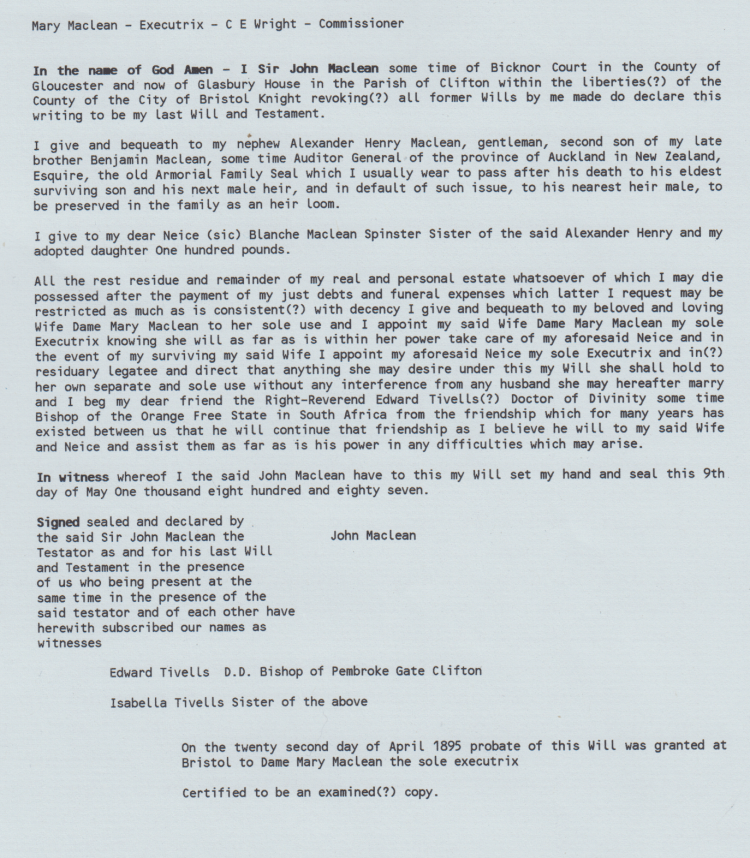
I note, with one exception, there was no mention of his colonial relatives in Sir John’s Will, his obituaries or the National Biography entry. A copy of his Will follows.
The exception was directing, in his Will, his red stoned Armorial Family Seal (snobbish snobbery, just more of the claimed Scottish ancestry) to his nephew Alexander Henry MACLEAN with the request that it pass to his nearest male heir and so forth.
I assume that it was not left to Robert or Every MACLEAN, as in 1887 when Sir John’s Will was signed, whilst they were his nearest male heirs, Robert only had a daughter and brother Every did not have a legitimate male heir. Benjamin of course had pre-deceased Sir John, but did have sons, the oldest of whom, my grand-father BJMc, had not married.
The next oldest, Alexander Henry Maclean, while married, left no sons and in his Will he left the Seal to my father, John Every MACLEAN.
Transcript of Sir John Maclean’s Will dated 9th of May 1887
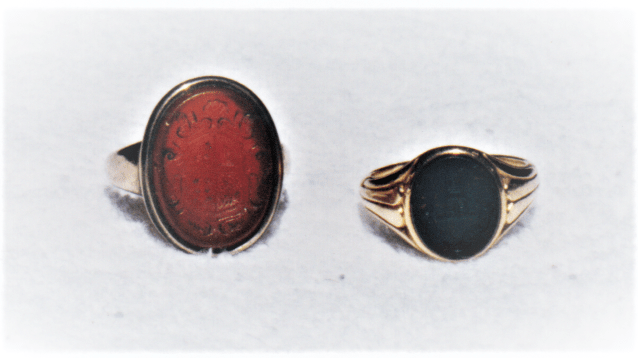
In his Will Sir John’s ring is described as
“…the old Armorial Family Seal which I usually wear…”
This so-called old Armorial [that is, relating to heraldry – Oxford Dictionary] Family Seal couldn’t have been, unless it was second hand, that old as he only took up the Maclean name in 1845. But let sleeping dogs lie, I have dwelt on the name change long enough.
As it turns out, I now have the ring/seal in question, as is fitting, as I am the oldest surviving Maclean, son of the oldest surviving Maclean etc. I have, however, never worn the ring.
There are two other black stoned red flecked armorial rings or seals, call them what you wish, in existence. I have one and the other is somewhere in New Zealand with the heirs of the late Rev. John Raglin Maclean. All three rings are seals in that the Maclean Clan inscriptions on them, are reversed so that if pressed into hot sealing wax used on closing a letter or sealing a document would read correctly.
Such practices are a thing of the past. Big fat diamond rings would have been far better!
An occupation for Benjamin Maclean
Benjamin (senior) was about 45 years of age when he landed at Auckland and had not worked on a farm for at least 15 years. His chances of establishing a successful farm in New Zealand on very limited capital, were at best, slim.
My reading of Benjamin Maclean’s financial situation is that he had a large family to support, had probably sold his farming inheritance some time in the 1840s, and was scraping by on a clerical job in the Post Office. He may have been getting some assistance from childless John and Mary Maclean who were probably quite happy to assist them on their way to New Zealand.
While there is some evidence that Ben was contemplating farming in New Zealand one suspects he was unable to afford the startup costs. However, fortuitously:
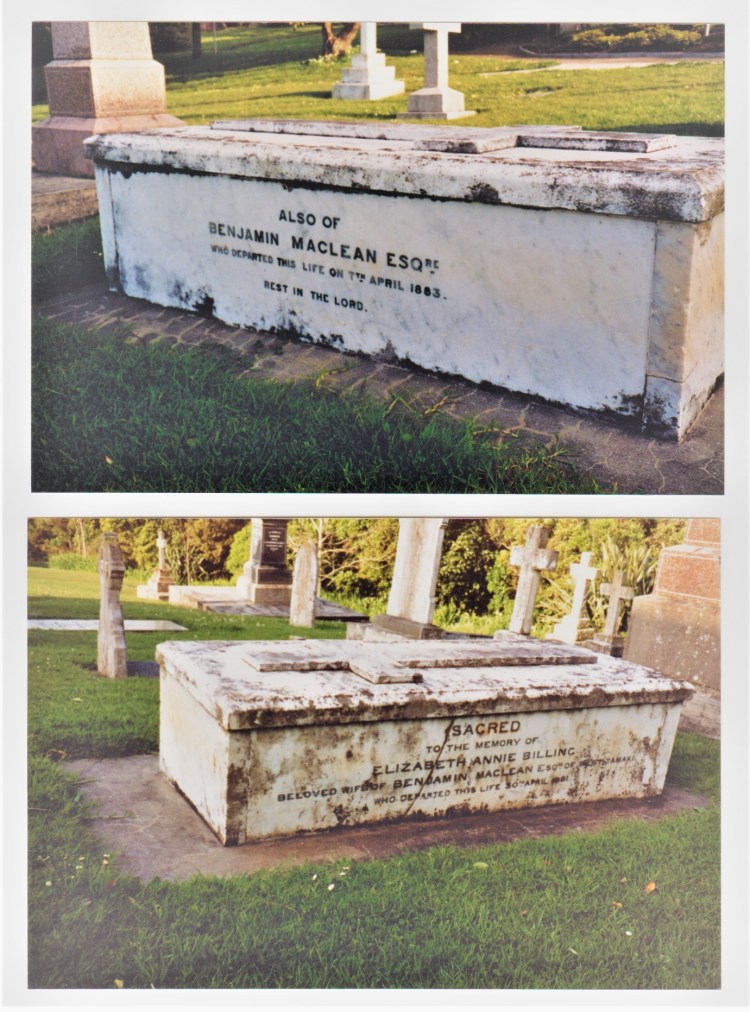
“On 15 January 1863 Benjamin was appointed Auditor-General of Public Accounts for the Province of Auckland. He also organized the Property Tax Department of Auckland, though the tax was later abolished. On the 28th of July 1864 he was appointed Auditor under the provisions of the Auckland and Dury Railways Act. On 6 January 1873 he was appointed a Justice of the Peace and on 17 March 1876 he was appointed a member of the local cattle Board.
“It is believed that he was also on the tutorial staff of St John’s College but unfortunately the college has no records of its staff in the early years. However, Elizabeth’s death certificate cites her place of death as St John’s College.
“Benjamin was a Synodsman for the Tamaki District from 1868 until his death, and Churchwarden for St Thomas’ from 1862 at least until 1870 and possibly until his death. St Thomas’s church building collapsed, and the chapel of St John’s was serving as the parish church instead, which perhaps explains why Benjamin and Elizabeth are buried beside St John’s Chapel.”
Quote taken from the revised edition of “The Macleans of Howick and Tamaki” page 117. There are other supporting snippets as follows:
- Mitchell article (History of Penrose Farm): ‘…Benjamin spent most of his life in this country as a member of the tutorial staff of St John’s College.”
- Atkinson article (Bleakhouse at Howick etc); ‘ Benjamin …. was a member of the tutorial staff of St John’s College and for many years served as Provincial Auditor.”
- “Finding my Past” Web Search quoting newspaper report that a Mr Benjamin Maclean sold livestock, including 50 Leicester ram lambs and 20 Leicester ewes at Newmarket, Auckland, NZ 1866.
I have not followed this up, but there is a good chance that this was Benjamin junior who was selling the livestock. Of course, it might also be a completely unrelated Benjamin Maclean. - NZ Herald, Vol xiii, Issue 4470, 11.03.1876 – notification of the appointment of Benjamin Maclean Esq. J.P. as Provincial Inspector of Lunatic Asylums (Papaka, Auckland).
- Wise’s NZ Post Office Directory 1880: “…Benjamin McLean [sic] works in the Land Tax department and lives in Parliament St, Auckland.”
- Obituary, New Zealand Herald, 9 April 1883.
“It will be seen from our obituary column that another old and respected colonist has passed away in the person of Mr Benjamin Maclean, who died at his residence, Tamaki West, on Saturday last. Owing to his indisposition, Mr Barstow had to be appointed as Judge of the Assessment Court for Auckland and various other districts. For several years Mr Maclean fulfilled the functions of provincial auditor, and subsequently organized the Property Tax Department in Auckland when that tax came into force. ….. He, along with his brother, Mr E Maclean, carried on extensive farming operations in the Tamaki district for many years….”
I suspect that the writer confused Benjamin for Robert with respect to the ‘extensive farming operations in the Tamaki district’. - In her death certificate of 1881 Ben’s wife is described as: “Wife of Property Tax Commissioner.”
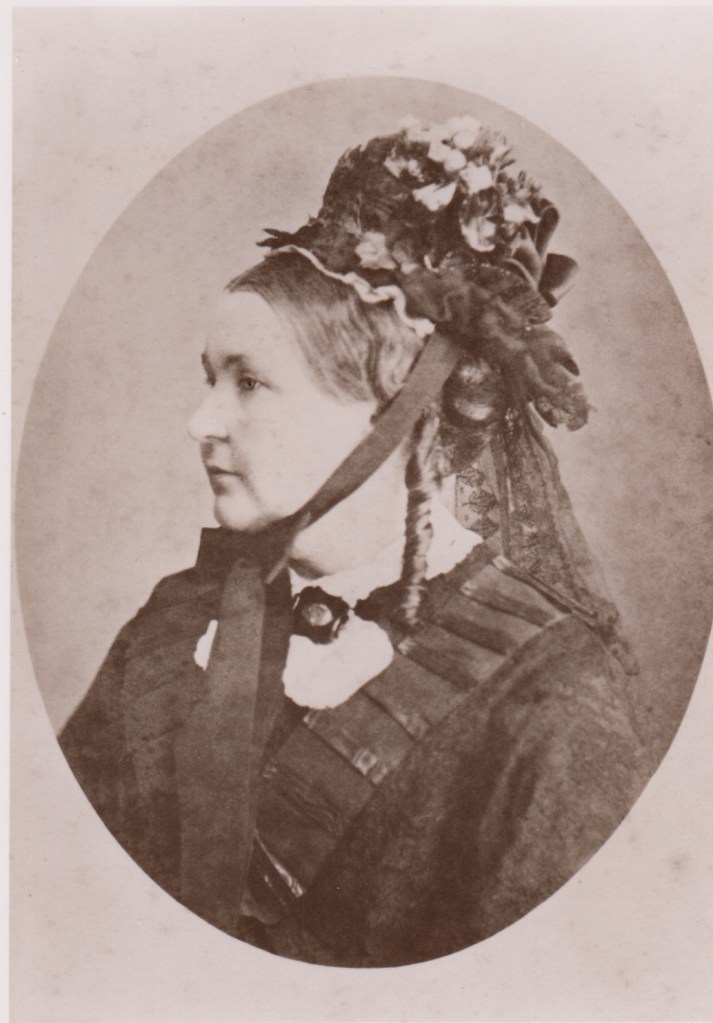
[Looks like a younger Queen Victoria?]
(Date Unknown)
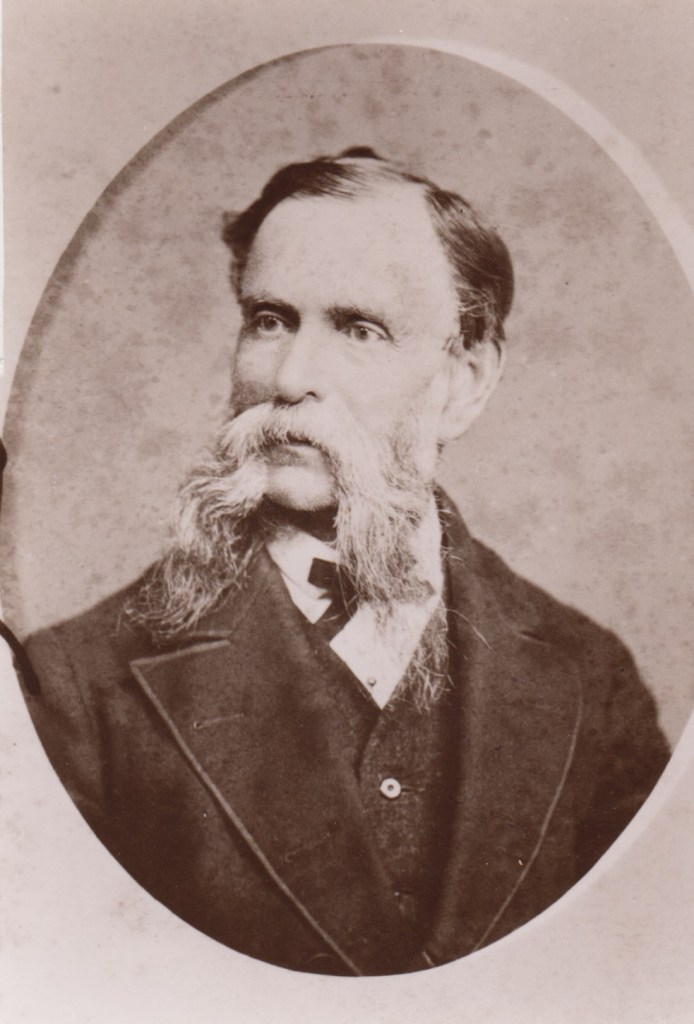
Benjamin John Maclean
Now where was BJMc all this time? Let us start with the date November 24, 1860 when young Ben was 6 days shy of his 18th birthday. On this, no doubt, exciting day the MACLEAN family were enjoying the end of a steering class voyage on board the good sailing ship ‘Rob Roy’ of 822 tons from London, as it entered the Port of Auckland. The following passengers were on the passenger list:
Benjamin, Elizabeth, Mary, Edith, John, Alexander, Christopher, Jeffrey, Bertha, Thomas, Lachlan, Reginald and John Maclean (Ref The Southern Cross, Tuesday, November 27, 1860).
This list doesn’t match the list of Ben and Liz’s children, I hear you say. Well the first two are the parents, the first John is BJMc, Blanche is not there as she stayed in England with her aunt Mary and uncle John (not to be confused with the Aunt Mary and Uncle John in the opening line of Little Richard’s hit-song Long Tall Sally), and we now have a Jeffrey who is Geoffrey, the 10 year old natural son of Thomas Every Maclean and nephew of Benjamin and Elizabeth, and whose upbringing was, apparently, now to be their responsibility.
“The Rob Roy is renowned for the remarkable passage from Auckland to London in 1865. She was a Clyde-built ship of 832 tons, with superior accommodation for passengers, and came out under the Shaw, Savill Company’s flag. She completed three voyages to Auckland, arriving there first on the 24th November, 1860, making the passage in 106 days.”
Source: Web Search, White Wings [sailing ships] Vol 1. Fifty Years of Sail in the New Zealand Trade, 1850 to 1900”. New Zealand Electronic Text Collection.
So BJMc had spent 106 days getting from London to Auckland. Nothing to it – a little over 3 months. Just 10 or so years earlier his two uncles, Robert and Every Maclean, had taken 139 days (from 28 Dec 1849 to 17 May 1850) in the ‘Constantinople’ which was a smaller sailing ship.
Having said that, the trip would have been no bed of roses. No doubt the older children had continuous child-minding duties. Five of the children were aged 10 years and under. The youngest was 3 years. And they all survived the voyage.
BJMc was the third eldest child and the oldest boy. And, as already stated, they were traveling steerage class, not the ‘superior accommodation’ referred to in the above quote.
“Steerage is the lower deck of a ship, where the cargo is stored above the closed hold. In the late 19th and early 20th century, steamship steerage decks were used to provide the lowest cost and lowest class of travel …. With limited privacy, inadequate sanitary conditions, and poor food, steerage was often decried as inhumane, and was eventually replaced on ocean liners with third class cabins.” Wikipedia Web Search June 2020.
So, the hard-up MACLEAN family travelled steerage. These early little boats that plied between England and Australia and New Zealand were primarily trading boats that only took on some paying passengers. It seems to have been an important function of local newspapers to list arriving and departing ships, passengers on board, and goods on board. There is an extensive list of the imports on board the Rob Roy, including casks of whisky, wines and spirits, drapery, pickles, kegs, barrels and casks, agricultural implements, candles, shoes and boots, ploughs, tea, private chests and parcels, apothecary wares, tobacco and pipes, bottled beer, nails, 100 tons of coal, 25 tons of pig iron, 127 cases of soap etc. The ones I liked most were 30 cases of champagne and 208 tons of steam coals.
BJMc 1860 – 1891
It seems safe to assume BJMc had completed his schooling in Cornwall and the other English towns where his father Benjamin worked in the Post office. He may have worked in some trade or capacity in England as a teenager before leaving with his family for New Zealand. He probably did not have farming experience as his father seems to have given that away in the 1840s. No doubt his initial years in New Zealand were spent with his father as he, the father, tried to establish himself as a farmer.
1865: Events in New Zealand in the 1860s were dominated by the Maori Land Wars. BJMc’s uncle, Every Maclean, had:
‘formed the Howick Cavalry Volunteers, of which he became captain, and the corps rendered good service in the protection of its Waikato district.’ – taken from an article entitled “Makers of New Zealand”, The Herald, 2 Aug 1929.
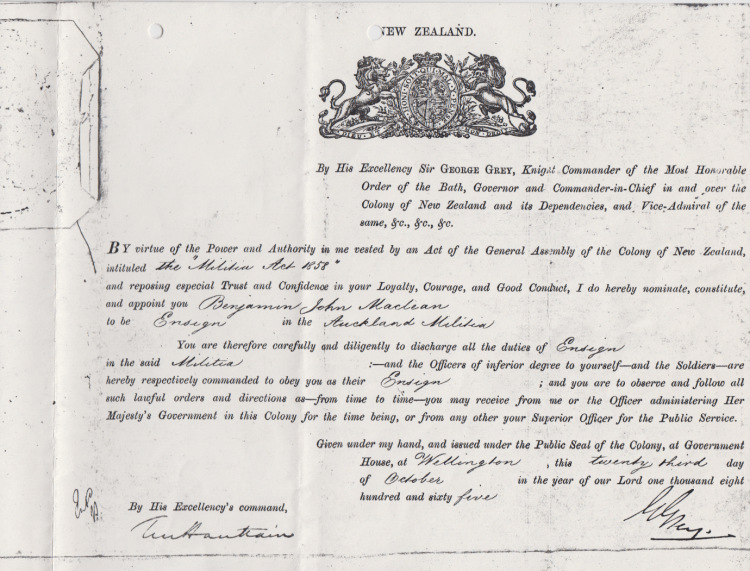
On the 23rd day of October, 1865, Sir George Grey, Governor and Commander-in-Chief over the Colony of New Zealand, signed a document at Government House Wellington, appointing BJMc to be an Ensign in the Auckland Militia.
I have not been able to find out how long BJMc held this appointment for and what his military career entailed. “Militia” implies he was appointed as a citizen force soldier, as opposed to being in an English regiment. There may be a service record for BJMc, but I have not pursued this line of enquiry. Some years ago, I donated the original parchment Deed Of Appointment to the Auckland Library and it can be examined on-line.
1875: The little I knew from my family was that BJMc was a mining engineer who came to West Australia from New Zealand to work in a gold mining enterprise in Kalgoorlie. Unfortunately, I have never discovered any reference to BJM’s engineering career in WA. My mother told me he was invalided in a mining accident and could not work again. As a result, his wife Jessie was able to work as schoolteacher (generally married women could not work in paid employment). My mother told me Jessie once taught my uncle-to-be, Herbert Shaw, who many years later married one of my mother’s sisters (the best looking one).
There is, however, some record of BJMc’s mining career in New Zealand. The Cyclopedia of New Zealand, Vol 2, Auckland, published Christchurch 1902, contains the following entry on p498:
“Mr Benjamin John MACLEAN, Mine Manager of the Te Ao Marama portion of the Waitekauri Gold Mining Company’s Mine, usually called the Komata section, was born in England, and was educated at St. John’s College, Auckland. He came to New Zealand with his father, the late Benjamin Maclean, Deputy Property Tax Commissioner, in the early days. Mr Maclean commenced his mining career at the Thames in 1875 and was afterwards for a good many years on the West coast. He has held the position of mine manager for several mines.”
This of course raises two questions – what did BJMc do after he was discharged from the Auckland Militia and where did he acquire his mining expertise. I don’t know and have not been able to find out. From memory there was once a mining school at Thames. I inquired of BJMc at the Thames School of Mines and Mineral Museum when I visited the Thames township, a number of years ago, but I was told the School started after 1875.
A small book of BJMc’s, entitled “Simple Tests for Minerals or Every Man his Own Analyst” by The Rev Joseph Campbell, 3rd Edition, 1895 has drifted through to me. It has a few of BJMc’s scribbled notes and paper clippings of the Kalgoorlie mining area but doesn’t look like the sort of book to build a prospecting career on. He owned a second book, a far more meaty tome, “Treatise on Practical Mathematics”, Chambers 1894, which doesn’t bear reading. Finally, there is an even more challenging book, inscribed Jessie Maclean 8th May 1914; “The Book of Common Prayer – according to the use of the Church of England”. It looks well used, but not by me!
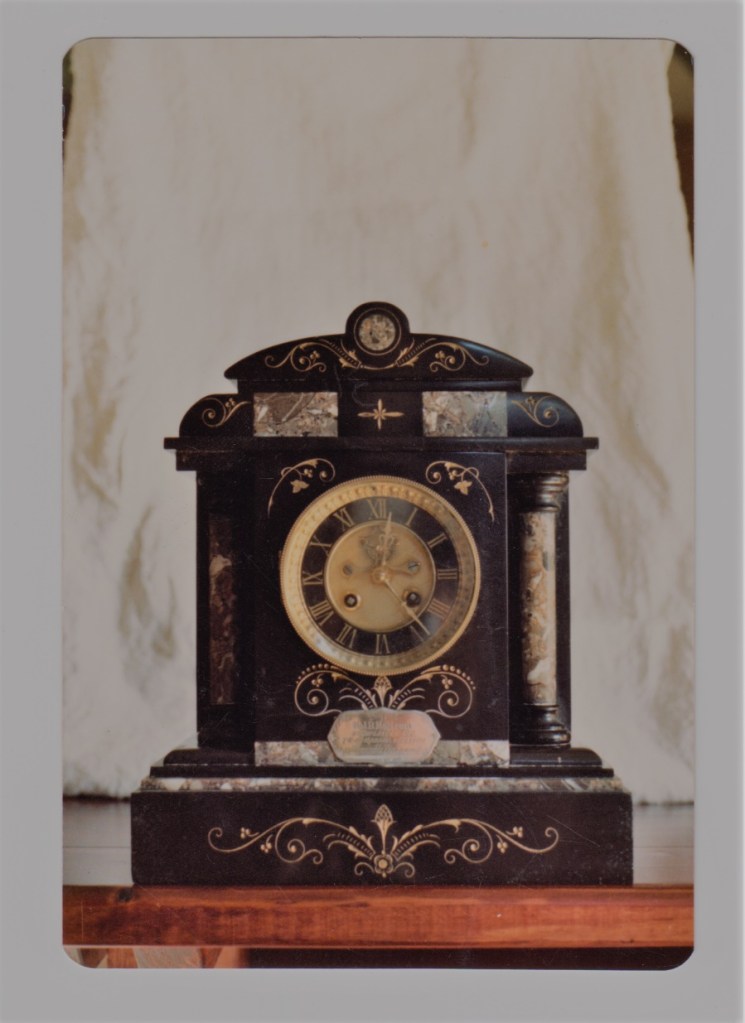
When BJMc left employment in New Zealand he was presented with a mantle-clock bearing the inscription:
“Presented to Mr J B Maclean by employees of TE-AO-MARAMA Section of the Waitekauri Goldmine.” (Clockmaker H Kohn, Auckland NZ)
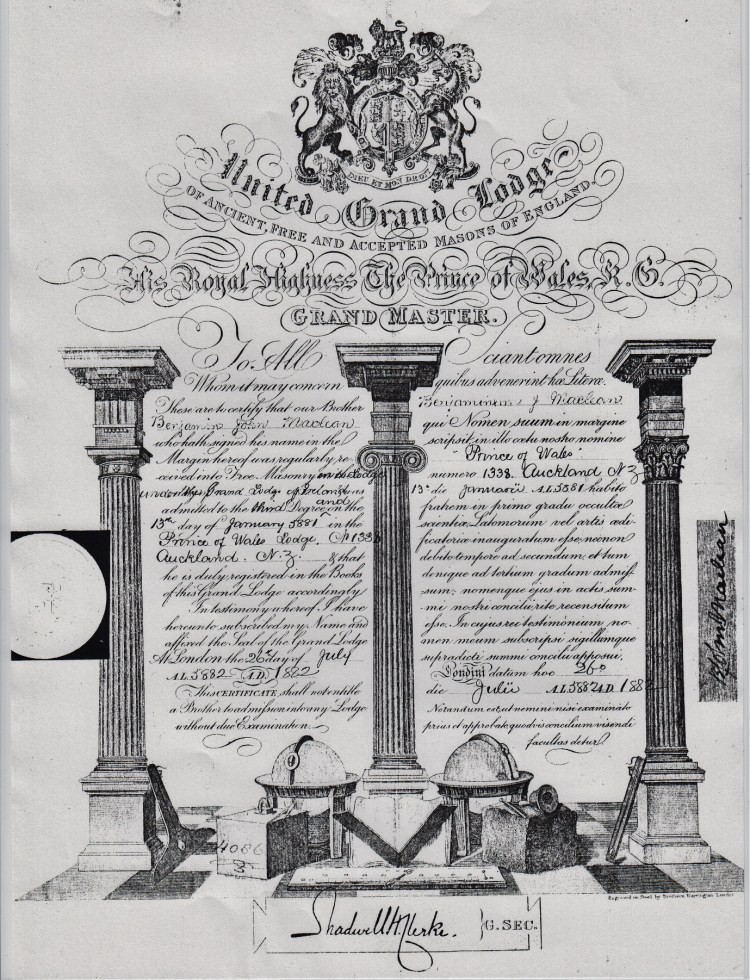
1882: On 13 January 1882 BJMc was admitted to membership ‘third degree’ in the Prince of Wales Lodge, Auckland, NZ. The parchment of his admittance bears his original signature on the right margin.
1884: BJM’s name appears as a shareholder of 1,250 shares (total shares issued 50,000) in an application to register the LORD WOLSELEY GOLD-MINING COMPANY(LIMITED), BJMc described as Benjamin John Maclean, Auckland, gentleman.
1887, 1890: Report from Colonial Secretary’s Office for Road Board Elections – BJMc elected as a member of the Road Board for Kirikiroron, County of Waikato.
1893: Report in the New Zealand gazette that the Governor in Council made Orders under the Public Reserves Act 1881 for the delegation of powers under the Act to a Board of 6, which included BJMc, the Board to be known as the Taupiri Domaine Board.
1891: And finally, on the 22 of August, 1891, BJMc, in his 49th year, married 27 yo Jessie Jones WHYTE, spinster, born 22 May 1864 at 3 Rotland Place, Govan, Glasgow. Jessie was the daughter of Thomas WHYTE and Maria Sophia nee JONES who married in Killinock Ireland, 26 Dec 1861. BJMc’s usual residence was given as Taupiri and Jessie’s as Parnell.
In later years mother-in-law Jessie told my mother that it was a mistake to marry an older man. BJMc lived to his 90s and was an invalid from some time in the early 1900s until his death in 1937. There was a 22-year age gap between the two.
On his marriage certificate BJMc described his profession as ‘gentleman’. This little bit of snobbery was also used by his father and three uncles on official forms, presumably because it implied independent means and an upper middle-class and not ‘yeoman’ birth. It was also used on the Blisland Church wall memorial for Robert Maclean.
Unfortunately, there was no profession shown for Jessie on the marriage certificate. I have never been able to find out when Jessie came to New Zealand or anything about her family or training, if any. She is a mystery woman – every family needs one. But according my web searches there is still a house at 3 Rotland Place, Goven, Glasgow.
Ben and Jessie produced two boys, my father, John Every MACLEAN, on the 8th of May 1893, and my uncle, Christopher Whyte MACLEAN, on the 14th of March 1896. John is recorded as having been born at Parnell NZ and Chris at Wanganui NZ.
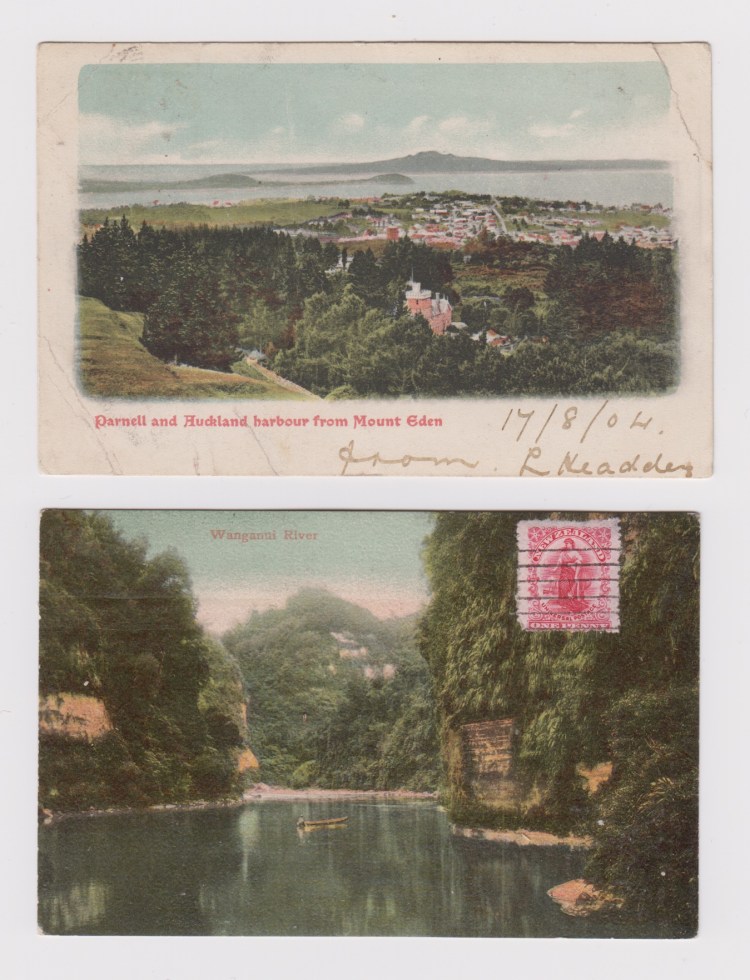
Two postcards, from the very early 1900s, of Parnell and the Wanganui River New Zealand follow. They have nothing to do with anything in this History!
 Maclean Family History