This history so far covers my (more or less direct) family of Leans and Macleans for roughly 250 years, starting in Southern England, then to New Zealand and finally Australia. In the beginning their main occupations were as farmers, agricultural workers and the running of households. As New Zealand and Australia developed we see a rise in other occupations such as public service and municipal administrators, the professions and the church. While there where a few with full time Defence occupations, many others were caught up in the major wars of the times. I want to briefly list these contributions for the wider Maclean family. Aside from limited personal knowledge, most of the military participation listed has derived from The Macleans of Howick and Tamaki, 2009 referred to earlier.
There may have been other people who served that I have missed and I apologise if this is the case.
1845
(Sir) John Maclean, started at UK War Office in his 20s, retired 1871 as Deputy Chief Auditor of Army Accounts, aged 60 years.
1848
James Bailey (husband of Ellen Maclean), British Commissariat Service – a civilian force operating on military service lines provisioning the army (served in Great Britain, Ireland, Cape of Good Hope, Turkey/Crimean war and New Zealand). In New Zealand he held the rank of Acting Deputy Commissary General.
1850’s
Henry Clutterbuck LEWIS (married Edith Louisa Maclean 1871), served in Crimean War, siege of Sebastopol, 1855 commissioned, 1856 appointed to Commissariat Department.
WWI
James Llewellyn Lewis (son of above) Major 10th Essex Regiment, France
1860’s
Captain Every Maclean, Howick Troop of Cavalry Volunteers
1860
Ensign Alexander Henry Maclean, Waikato Volunteers
1865
Ensign Benjamin John Maclean, New Zealand Militia
1893-07
Thomas Billing Maclean, Chaplain to 2nd Wellington Rifle Battalion. Buried with military honours.
WWI
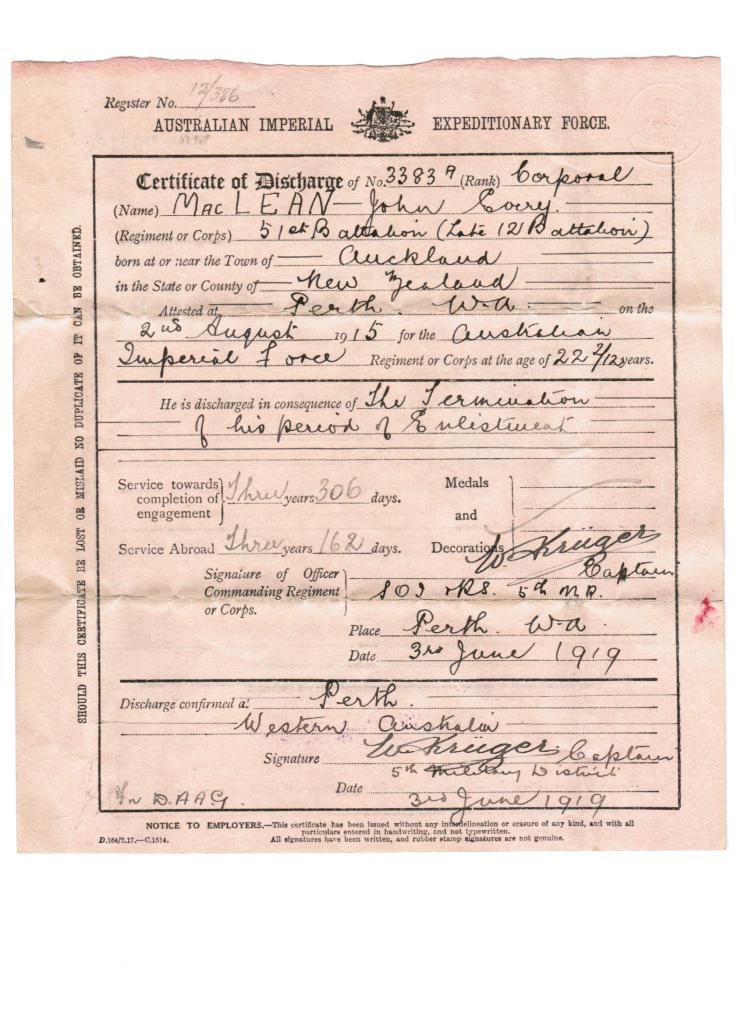
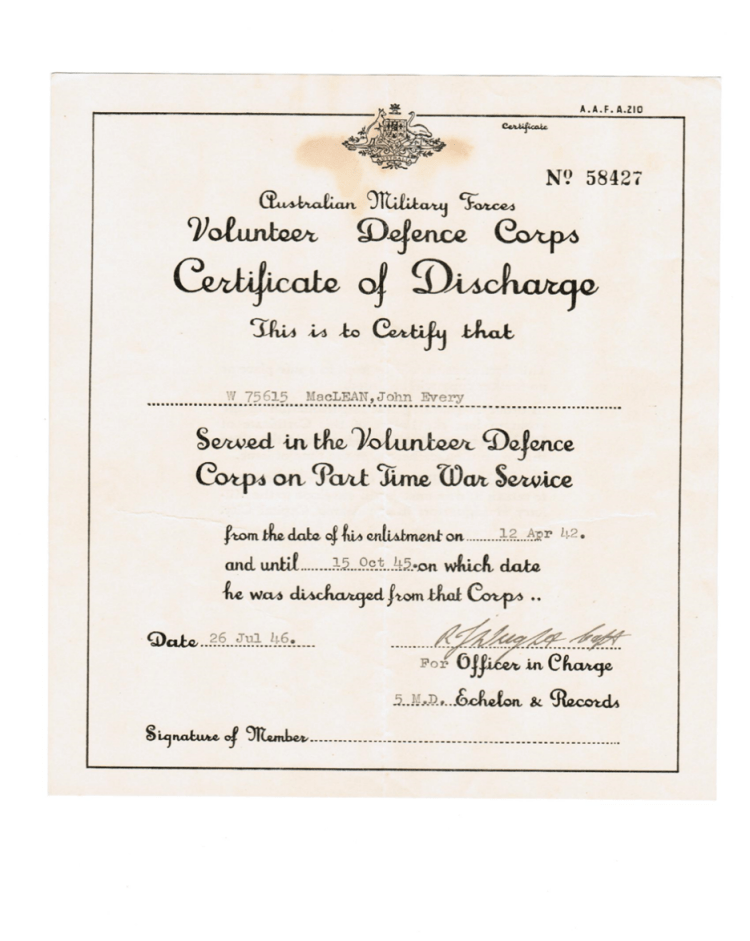
Cpl John Every Maclean 1st AIF, 52nd Bn. WIA in the trenches of France. Served as Sgt in WW11 in a troop training capacity and in the Volunteer Air Observer Corps.
To read more about Cpl John Every Maclean, the button below will take you to read the book written by John D Maclean titled Not Such a Great, Great War.
The book covers the war history of the 70 men who trained in Western Australia in the unit 11/12th Battalion Reinforcements.
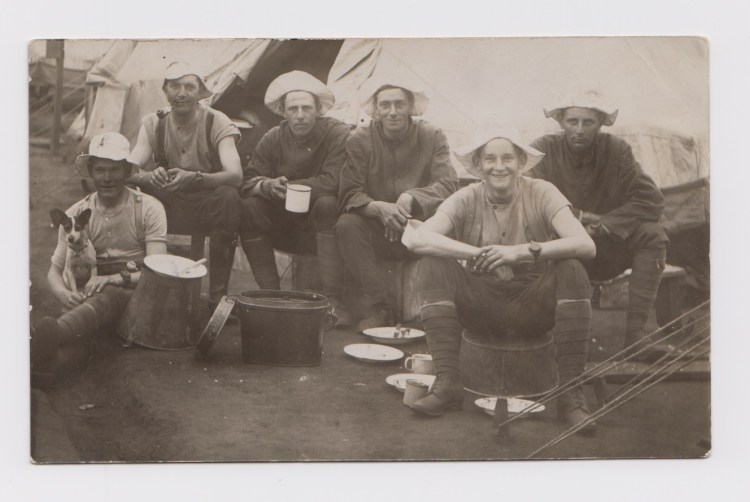
These soldiers embarked for the trenches of France in June 1916. The two soldiers in the centre were both killed within a month of landing. JEMc is at the right rear. His friend, later (machine gunner) Sgt John Marshall MM, in front of him, survived WW1.
When WW11 came, Marshall was a civilian customs officer in PNG. He was murdered by the Japanese in Rabaul for hiding in the jungle with some planters and one of their wives, and not surrendering after Rabaul was overrun. On capture all the men were murdered and the woman sent to a local brothel.
By then, Rabaul’s other civilians (except for 4 men who knew how to operate the ice works) and military POWs, 1,053 in all, had been loaded onto the Japanese trading ship Montevideo Maru, unmarked as carrying POWs, and sent to the Philippines. On the way it was sunk by an American submarine – Australia’s greatest maritime disaster. There were no survivors amongst the prisoners.
WWI
Lt Lionel Herbert Maclean, 1st NZEF, Nth Africa and Europe
WWI
Eric Wanklyn Maclean, NZEF, Commissioned Gallipoli
WWI
Christopher Nelson Maclean, NZFA, served in France as a gunner
WWI
Lt Francis (Frank) Maclean, Royal Field Artillery, France, middle east
WWI/II
Air Vice Marshall Cuthbert Trelawder Maclean, CB, DSO,MC, Legion d’Honneur (France) – long full time career
WWI
Eric Trelawder Maclean – at Gallipoli with NZ Infantry. KIA May 1915
WWI
Keith William Maclean, Aust Army, Artillery, France and Belgium. WW11 Capt. in Volunteer Defence Corps
WWII
Antony Russell Maclean. Served with NZ Division in North Africa and Italy.
WWII
Lt Col Alfred Lionel Noakes -married to Robert Maclean’s granddaughter, doctor in Middle East and Italy.
WWII
Robert Lancelot Maclean (son of Geoffrey Maclean), engineer in Royal Navy
WWII
Frederick Robert Andrews (husband of Margaret Joan Maclean). Joined (NZ) Territorial Army and Aifforce prior to WW11, served in Pacific, rose to Sqd Leader.
WWII
Corporal Christopher Whyte Maclean, Intelligence Section, 20th Brigade Headquarters, 9th division AIF – Rat of Tobruk, mentioned in dispatches Battle of El Alamein.
Christopher Whyte Maclean was my uncle and my father’s brother and only sibling. He enlisted on the 24th of May 1940, aged 44 years (born 16 March 1896). As with the 2 Sandakan soldiers at the end of this section, Chris was married with 3 children when he enlisted. He fibbed in 4 places on his Enlistment Attestation by claiming: that he was 35 years 2 months of age, that his date of birth was 16 March 1905, that he was a natural born (illegitimate) and that he was born at North Freemantle W.A. He served 862 days overseas before being discharged at his own request on compassionate grounds (his son Douglas – see below – being killed in a training accident). At enlistment he said he was a draftsman (commercial artist). A quick self-portrait sketch from his army days follows.
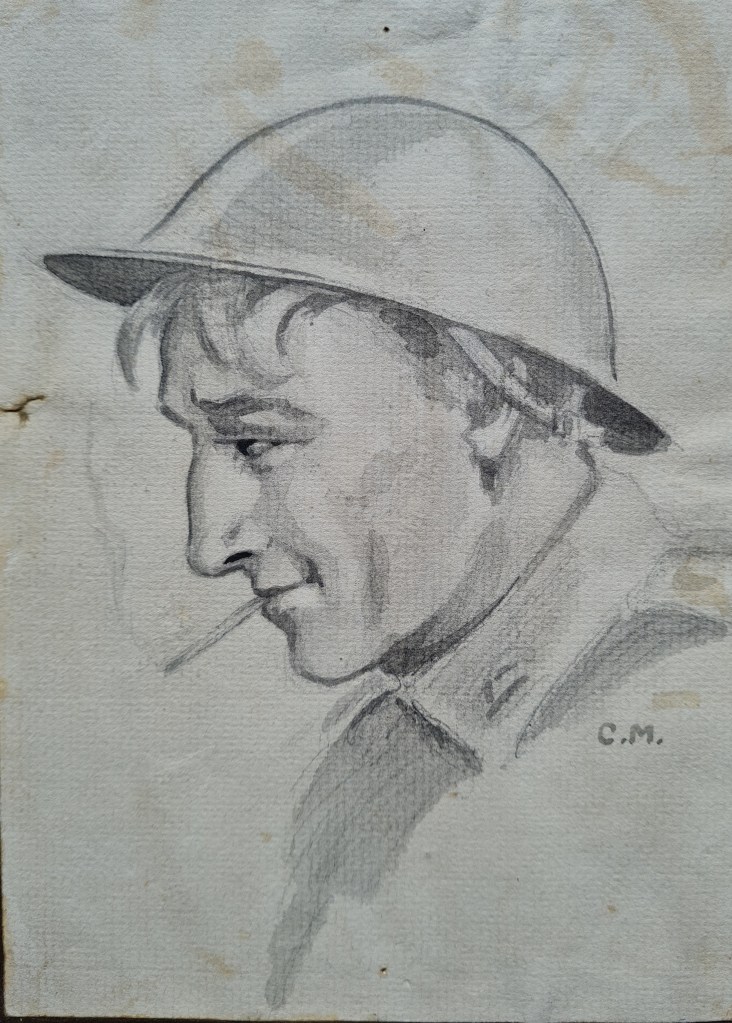
Christopher died aged 70 years on the 7th of August, 1966 at Wentworth Falls, NSW. Unfortunately, I never met my uncle.
His son Gunner Douglas Maclean (see next entry) also fibbed about his age on enlistment, claiming that he was 18 years and 10 months old when in fact he was a full 2 years younger. I notice on his enlistment he described his Occupation as “Station Hand”, but I suspect that young Douglas would not have known the front end from the back end of a horse or cow. Douglas is the tall soldier in the following photo.
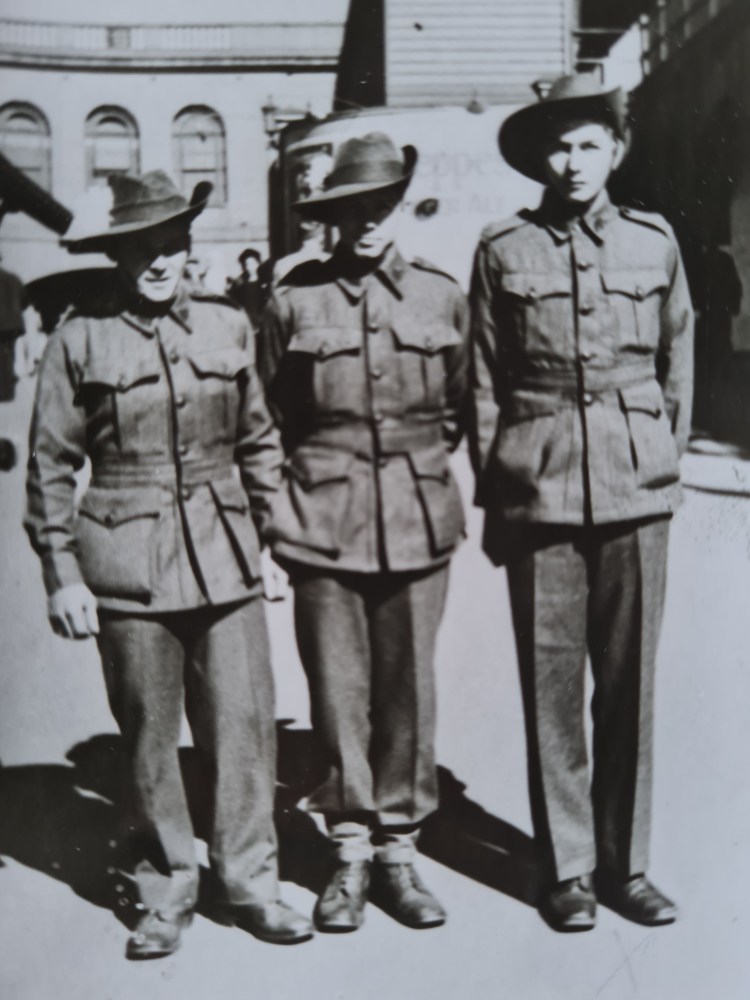
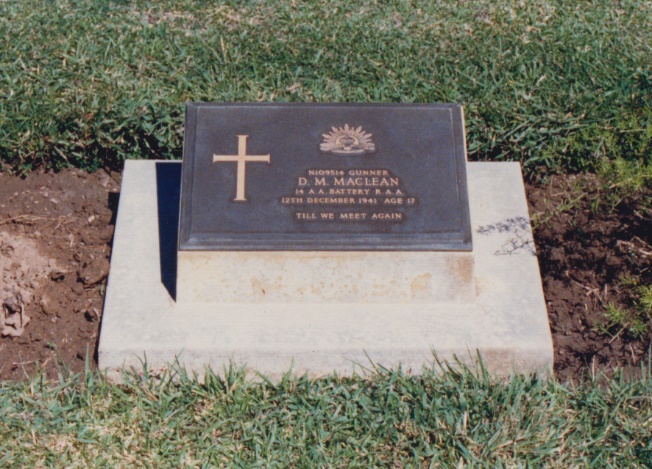
Sometime earlier in his life Douglas must have suffered a serious accident as his Service Record, under Distinctive Marks, records scar burns to both shoulders and arms, thigh, chest and abdomen and right side of neck. Gunner Douglas enlisted on 28 April 1941 and was pronounced dead on 16 December 1941 in Darwin.
In 1997, when I was researching Christopher and Douglas through army records, I was informed that Gunner Douglas was entitled to 3 medals which had not been claimed by his family. I passed this information on to his sister Mrs Christina Campbell who said that the ‘non-claiming’ would have been a decision of her mother who was very bitter about her son’s death and would have nothing to do with the military. [In fact, after the Army letter telling me about the medals someone from the army records area rang me to say the medals had originally been sent to Douglas’s mother as his n.o.k., but she had returned them – I also passed this information on the Christina]. I recall Christina writing later saying she would claim Douglas’s medals for the family.
Christina had written to me earlier in 1989 saying:
“[the family] had never been able to find out how Douglas died. One of his friends said he was blown up on manoeuvres but nothing official. As it happens his groups were later sent to Timor and captured by the Japanese so maybe it was for the best. Peter [Christina and Douglas’s older brother – Peter John MACLEAN] – also joined the Army… they made him a P.T. instructor… after Doug’s death he managed to transfer to the Merchant Navy and sailed on the Queen Mary [operating as a troop ship] throughout the war.”
Gunner Douglas’s Army Service and Casualty Form, for 16.12.41, blandly records that he died 7 M D [medical district] cause not given. His Death Certificate says he died of Acute Ulcerated Carditis and Multiple Abscesses of the Lungs and that he died in the Bagot Hospital Darwin. I assume there was some form of Army Inquiry (cover-up) but that certainly was not released to me.
WWII
Gunner Douglas McElroy Maclean (son of above) Anti-Aircraft Gunner accidently killed on active service, Darwin 1941, aged 17 years.
WWII
Christopher David Maclean, Pilot Officer RNZAF, KIA
WWII
Peter Alloway Maclean, Lt Royal Aust Navy (brother of CDMc)
WWII
Roger Stephen Maclean, seconded from RNZN to Royal Navy, served Indian Ocean and Europe (bother of both above).
WWII
John Raglan Maclean MM, 2nd NZEF
WWII
James Nelson Maclean, 2nd NZEF, Capt. Acting Major 1940-45
WWII
Margaret Ester Maclean, 2 years in Land Army
WWII
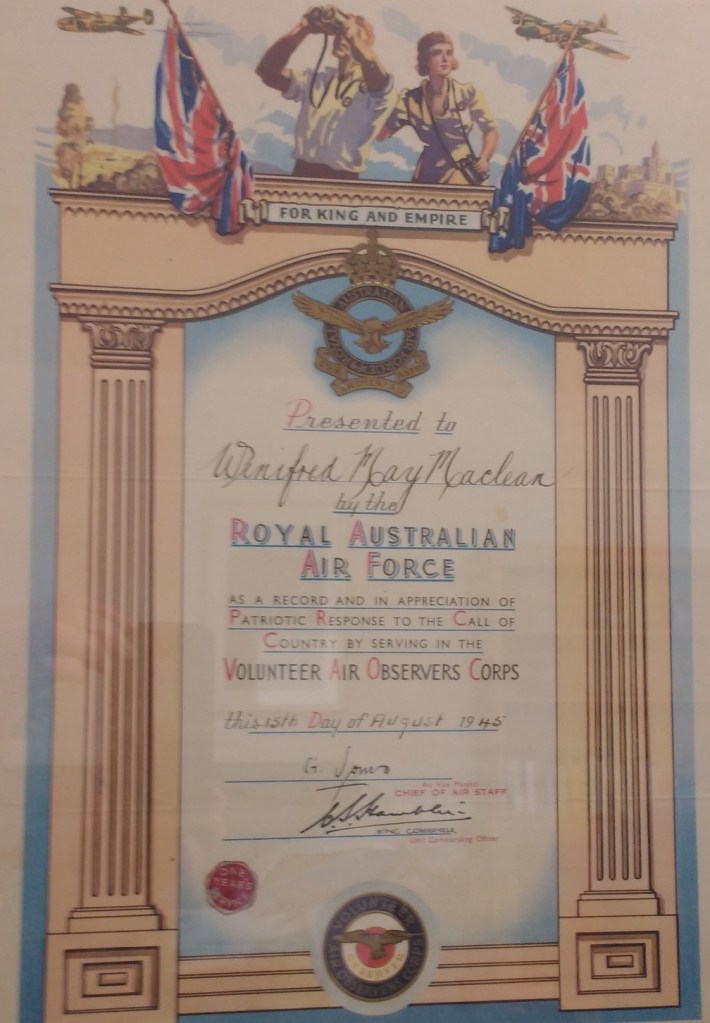
Winifred May Maclean, Volunteer Air Observers Corps
WWII
Dr Charles Macdonald ROSS (mar Anne Margaret MACLEAN 1940) Major in RAMC 1942 to 1946
WWII
George Cyril Coward (my father in law), Squadron Leader, DFC, 3 Sqd RAAF, North Africa
WWII
Derek Brayton Barker (grandson of Geoffrey Maclean), 1940 with Seventh Anti-Tank Regiment Greece and North Africa, became POW
WWII
Godfrey Hubert Maclean, served in Home Guard, received medal for bravery
WWII
Raymond Douglas Bull (Robert Maclean family). Army reserve Malaya, Mounted Rifles NZ, T Force Tonga.
Korea
John Douglas Maclean, RAAF airframe fitter, 77 Sqd
Korea
Col. Ian Hubert Maclean MBE. Also served in Malaya and Vietnam.
Vietnam
John Richard Sherriff (grandson of Margaret Elizabeth Maclean), NZRA, platoon commander, WIA, resigned 1980 with rank of Major
Nat Service
John Maurice Priestley (Robert Maclean family). In late 1960s volunteered for NS, Territorial Army Officer 6RNNZIR.
Aust Army
John David Maclean, conscripted, Sgt Psychology Corps, Australian Army, April 1967 to April 1969 and 4 years in the Emergency Reserve.
I know there will be other family members with military experiences, that I am not aware of, such as men who married Maclean women and their offspring, but as family researchers often find, tracing such people can be difficult.
I just want to finish this research with two sad family histories from WWII.
My only sister’s father-in-law, Private Alvin Cedric Willmott and my first wife’s grandfather Private Robert Pallister, both married men each with 3 children and a wife, enlisted in the Australian Army in the early 1940s. There was a recruitment drive due to a finally perceived looming threat of Japanese militarism. Many married men with families, who had suffered unemployment and hardship following the depression, enlisted, often lying about their age. I doubt if either man entertained any though, given their age and likely postings, that they would end up in a front-line combat area (Singapore) and become POWs.
Alvin enlisted at Claremont, Perth, WA and was eventually posted to the 4th Reserve Motor Transport Company.
Robert enlisted at Newcastle, NSW in June 1940. He was a male nurse and was posted to the 2/10th Field Ambulance Unit.
Unfortunately for them, war broke out and they were shipped to Singapore around August 1941. After the capitulation of Singapore in February 1942 they became prisoners of war and were sent to Sandakan in Borneo (many more POWs went to the Thai-Burma railway). They all endured poor accommodation, inadequate food, punishment and beatings, maltreatment and untreated disease and injury. Their task in Sandakan was to work on airfield construction with only rudimentary tools. Eventually the tide of war turned.
“In 1945, in response to an order from the Japanese High Command that no prisoners were to survive the war those still able to walk were sent on a series of death marches into the interior. Anyone unable to keep up was ruthlessly murdered. Those left behind were systematically starved to death, or massacred. Of the 2,434 prisoners [both Australian and British] incarcerated by the Japanese at the Sandakan POW camp, only 6, all escapees, survived.”
From “Sandakan: A Conspiracy of Silence” by Lynette Ramsay Silver, Sally Miller Publishing, 1998.
I tell this story as I expect there is a high probability that, at the end of their lives, Alvin and Robert knew each other well. Both had spent years together in the Sandakan POW camp where the older men handled POW life better than many of the younger men. Both died on those final marches: Robert on 5 June 1945 aged 42 years and Alvin on 29 June 1945 aged 40 years.
My first two sons are Robert Pallister’s great grandsons and my sister’s four children are Alvin Willmott’s grandsons and granddaughters. Alvin Willmott’s only daughter, Anita Willmott, was at school when news of her father’s death reached her mother. Years later she wrote the following for a school class on her father’s enlistment and death.
POW PROFILE
Alvin Cedric WILLMOTT
Private WX 10178
11 th Res Motor Trans Coy
A.A.S.C.
Script written and spoken by Anita Willmott for Anzac Service at Mercy College, Koondoola in 1995
WORLD WAR II: LOOKING BACK THROUGH THE EYES OF A CHILD
My experience of the Second World War began on 18 December 1940 on the day that my father enlisted in the Australian Army. I was six years old. You will notice that I refer to this man as “my father”. At the time I only knew him as “Daddy”, and have never had the chance to call him by the older name of “Dad”.
In reply to one of his cousins who asked him why he enlisted, my father wrote:
“As you say, I did honestly see it as my duty. I had much more
to fight for than many others, – four responsibilities, etc. as you said.
Several misguided people tried to dissuade me from going, but I fear
they did not know how pigheaded a Willmott can be”.
The four responsibilities were us, his children, – my two brothers, Peter, seven, and Garnet, four, my cousin, John, who lived with us, who was five, and myself aged six.
I was never really aware that there was a war on, or that my father had enlisted. All I knew was that our family life changed. The boys were sent off to a country boarding school. I was taken to Perth to stay with family friends in West Leederville. My mother stayed in lodgings in Perth while she was waiting for my father to complete his Army training in Northam. In this way, although at the time I was not aware of it, I was the last member of my family to see my father alive – a precious memory.
Five months after enlistment, in April 1941, WX10178, Driver Alvin Cedric Willmott, a private in the Australian Infantry Force (AIF) was sent overseas in a troop ship to Malaya. His letters merely said “ABROAD” with no address. He worked as a dispatch rider taking messages by motorbike from one section of the Army to another. Technology was not so well developed in those days.
At the capture of Singapore on 15 February 1942, my father was taken prisoner by the Japanese. The last letter my mother received from him was dated 26 January 1942. In that letter, he said the bombs were getting closer, the night skies were filled with searchlights, and that it was hard to write “things uncensorable that he could tell us”. They could not disclose their whereabouts. My mother heard nothing more for over five months, during which time my father was reported “missing – whereabouts unknown”.
Subsequently, on 19 June 1942, my mother received a letter card from my father posted from a Japanese prisoner-of-war camp, country unknown; then, some time later, another card, with no date, no address, written (or rather the four lines were typed) from a POW Camp, Borneo. These were stamped with Japanese printing.
On 15 August 1945, there was the ceasefire against Japan, and subsequently the Japanese signed their surrender to the Allies. The whole countryside rejoiced and went crazy with joy. By this time, I was in country boarding school, and all the boarders were given a holiday. I really looked forward to seeing my father again, although by this time, I was eleven, and my father’s image had become rather blurred.
After the war was declared over, my mother avidly watched the newspaper lists looking for my father’s name in the troop ship companies returning to Perth. On the 29 October 1945, over two months after the war ended, she received a War Office dispatch saying that Alvin Cedric Willmott had died in Borneo on 29 June 1945, – six weeks before the war ended. The Dominican Sisters at my boarding school called me out of school to tell me that my father had died. I was given the day off school. There was no family around to be with me.
From information that has come to light since then, my father had been in the prisoner-of-war camp based at Sandakan, Borneo. He died from dysentery and malnutrition. Their total food supply for the day was a handful of rice. Apparently he was too weak to go on the first march from Sandakan to Ranau, but all the sick prisoners-of-war who were left behind on the first march were forced to go on the second so-called “death march” which took place during May and June 1945. My father did not survive, but died somewhere before they reached Ranau, Borneo. There is no grave to visit.
All during my childhood, I always expected to see him come around a street corner at any time, and I would recognize him. It was hard to believe that he had gone forever. It always made me sad to sit on a beach and watch the ocean. You see, – my father went overseas and didn’t come back.

Alvin Cedric WILLMOTT
WILLMOTT
Alvin Cedric
WX10178
11 Res Motor Trans
B Force to Borneo
Born Northam WA
Died June 29 1945
Ranau No2 Camp
from ‘Acute Enteritis’
Aged 40 years
from Perenjori WA
 Maclean Family History